
By Sara Beth Williams–
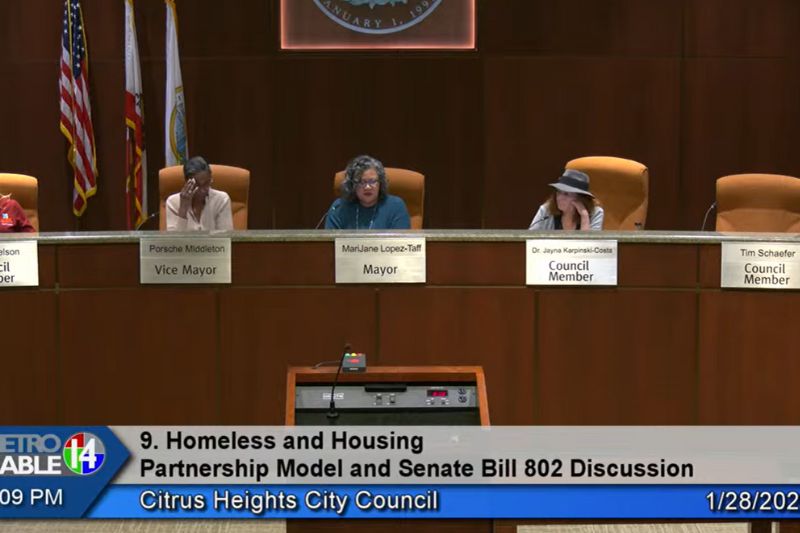
The Citrus Heights City Council voted to take a neutral stance on a revised housing and homelessness partnership model presented by Sacramento County during its Jan. 28 meeting.
The proposal centers on restructuring how jurisdictions across Sacramento County collaborate on homelessness and housing issues through a joint governance model.
Earlier in 2025, Sacramento County presented an initial partnership framework to all cities in the county. The effort seeking collaboration from local jurisdictions culminated in a multi-jurisdictional roundtable meeting on Oct. 28, where mayors, city council members, and the Sacramento County Board of Supervisors discussed regional coordination on homelessness and housing.
Following several hours of discussion at the October meeting, Mosaic Consulting Firm recommended revisions to the county’s original partnership models. Sacramento County staff later returned to individual city councils with a revised proposal that emphasized using existing administrative structures rather than creating a new board.
“The main difference in the current recommendation is that we use the existing administrative infrastructure that we already have with the continuum of care board,” Sacramento County Director of the Department of Homeless Services and Housing (DHSH) Emily Halkin said.
Under the revised model, the Continuum of Care board would be reconstituted to include at least 51 percent of seats held by elected representatives while still retaining community members.
The current Continuum of Care board consists of four elected officials from the City of Sacramento and the Sacramento County Board of Supervisors; 12 government staff members, including law enforcement; five nonprofit staff members; and eight community members, for a total of 29 people.
Halkin said the new partnership model serves to solve the problem of “no direct connection” between the current continuum of care board’s work and the policy decisions and goal-setting processes of local jurisdictions. The current board doesn’t implement cross-jurisdictional funding or set community-wide policy and strategy goals. To do this, the reconstituted model would require the board to publicly agendize meetings and adhere to the Brown Act, whereas currently the Continuum of Care does not do so.
Councilmember Jayna Karpinski-Costa questioned the effectiveness of the current Continuum of Care board due to its size and limited elected officials and asked whether a newly constituted board would still retain 29 seats.
No recommendation was made regarding the total number of seats on the board. Halkin said the only two seats mandated by the federal government and the state include one seat for a person with lived homelessness experience and one seat reserved for a youth.
Mayor MariJane Lopez-Taff expressed frustration with the current structure, saying almost nothing was achieved during the last Continuum of Care board meeting that she was “allowed to attend” as part of an advisory committee she was assigned to in 2024. Lopez-Taff said she supports adding a majority of elected officials and opening meetings to the public. At least two councilmembers questioned whether 51 percent of electeds would be enough.
Questions were also raised about local funding protections. Halkin emphasized that local funding would not be pooled under the county’s model.
“The only funding that would be at play in the county’s model is the CoC funding, which serves the entire county, as well as the homeless and housing assistance program state funding,” she said. “Our proposal is to lift up the CoC to be closer to the work the local cities are doing.”
While the Sacramento County Board of Supervisors has voted unanimously in support of the proposal, the existing Continuum of Care board would need to vote to approve its own reconstitution. The county does not have the authority to restructure the board unilaterally.
If the Continuum of Care board declines to adopt the revised model, the county has proposed an alternative option that would involve creating a new board composed of elected officials, subject to the Brown Act. Under that scenario, the existing Continuum of Care board would continue handling administrative duties, while the new board would set communitywide strategies, goals, and policy direction and establish a formal relationship between city councils and the Board of Supervisors.
Halkin told the council that the Sacramento City Council has voted 7-2 in favor of forming a joint powers authority, an approach the county does not support.
Councilmember Porsche Middleton expressed concern about maintaining local control, particularly under a joint powers authority structure. She warned that smaller suburban cities could be outvoted and said establishing a JPA could erode local authority. Middleton said the county’s proposal offered an opportunity to evaluate whether regional collaboration could work without sacrificing that control.
The City Council also discussed Senate Bill 802, which proposes the creation of a Sacramento Area Housing and Homelessness Agency, or SAHHA. The bill would restructure the Sacramento Housing Redevelopment Agency within the goal of consolidating regional housing and homelessness programs and funding.
If passed, the bill would change the governance of housing and homelessness initiatives across the region, and it would create an 11-member board of electeds, including three from the city of Sacramento, three from Sacramento County, two from Elk Grove, and one each from Citrus Heights, Rancho Cordova, and Folsom.
Initially, Citrus Heights, along with other cities and Sacramento County, opposed the bill because it would eliminate local control over funding that is allocated to each city. The new partnership model, Halkin said, whether the first option combining with the CoC or the alternative option without the reconstitution of the CoC, would allow jurisdictions to retain control of local funding sources while still achieving the goal of working closer together.
The City Council voted 4-1 in favor of taking a neutral stance regarding the proposed partnership model, with Schaefer voting no from a remote location. The decision to remain neutral defers the final decision to the Sacramento County Board of Supervisors.