



By Sara Beth Williams–
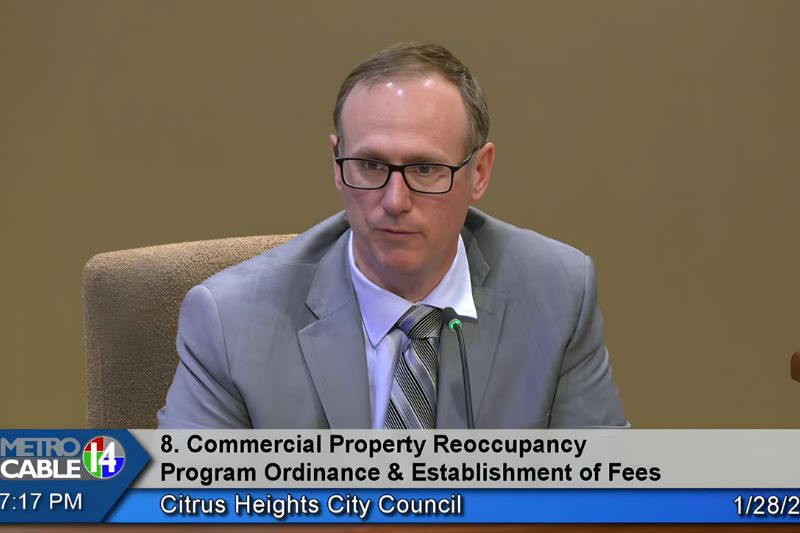
The City Council unanimously advanced a commercial property reoccupancy program Wednesday evening through the approval of an ordinance that has been in development for roughly half of a year.
The proposed Commercial Property Reoccupancy Ordinance establishes a framework requiring owners of vacant commercial buildings to register their properties with the city and maintain minimum safety, security, and aesthetic standards during periods of vacancy. City officials have said the program is intended to prevent blight, reduce public safety risks, and encourage reinvestment in existing commercial spaces.
The ordinance has undergone three revisions following received feedback from various stakeholders, including the Sunrise MarketPlace and Citrus Heights Chamber of Commerce boards, other local property owners and business owners, and the Citrus Heights City Council in September 2025.
Schaefer complimented city staff Wednesday night, saying staff did a “great job” explaining the program to the business community, and Chamber of Commerce in late 2025, but acknowledged that implementation will take “a lot of work” due to absent or unknown property owners, or owners who do not respond to city staff reaching out.
In research conducted during the drafting process, city staff examined other similar ordinances and connected with at least five other jurisdictions in order to study ordinances and implementation processes.
After first proposing the ordinance to the council in 2025, the city sent out over 400 letters to property owners to both inform them of the potential ordinance and gauge the level of support. City staff said only three property owners responded to the letters, and at least 20 letters were unable to be delivered.
“Three responses really bothers me,” Councilmember Jayna Karpinski-Costa said.
Economic Development and Community Engagement Director Meghan Huber reported that one out of three property owners who responded said they would support the ordinance.
The city emphasized that the program prioritizes proactive compliance over full cost recovery. Property owners who self-register their vacant buildings within 60 days and meet minimum safety, security, and appearance standards are eligible for fee waivers and may incur no cost.
Previous versions of the ordinance required property owners to register any vacant spaces within 30 days.
Property owners whose parcel is one acre or less and don’t qualify for fee waivers will pay $1,092 to register annually, and a $1,128 annual monitoring fee, totaling $2,220. Property owners whose parcel is larger than one acre will pay $6,600 total in annual fees.
The revised ordinance expands the criteria for waiving or reducing fees, including providing partial monitoring fee credits to property owners who are able to fill a vacant property within one year.
Property owners may also request relief from annual monitoring fees if their buildings remain in good repair, generate no nuisance activity, and have not required recent code enforcement or excessive public safety responses.
Other exemptions apply, including for properties undergoing active construction with valid permits and diligent progress, as well as partially vacant office buildings that are at least 50 percent occupied and free of recent code violations.
Other revisions in the new ordinance included streamlining the application process to allow property owners to use one application for multiple properties.
Vacant commercial buildings, staff noted, are particularly susceptible to vandalism, trespassing, and deterioration when left unmaintained. Over time, deferred maintenance can lead to escalating enforcement costs, loss of viable commercial structures, and diminished economic vitality along key business corridors.
The overall goals for the program are to help owners be proactive, Community Development Director Casey Kempenaar said, referencing the destroyed interior of the former Elephant Bar restaurant and explaining how the building’s demise could have been prevented through stronger security of the building including an active alarm system.
Owners of qualifying properties who register with the city must also provide management contact information, proof of insurance, and confirmation of active security monitoring, which officials said will help the city collect up-to-date contact information, and will help ensure properties are protected and maintained in order continue to remain viable for reoccupancy.
The ordinance establishes maintenance standards requiring properties to be kept free of trash, debris, and graffiti; secured against unauthorized access, and visibly posted with current owner or property manager contact information.
Properties without functioning fire and burglar alarm systems must employ continuous physical monitoring by a licensed security service. Ongoing inspections will be conducted to verify compliance, with enforcement actions available if violations persist.
Kempenarr said the program will undergo an initial implementation phase which could take months, during which the city will establish internal procedures, develop fee collection systems, and conduct outreach to commercial property owners and stakeholders before the ordinance takes effect.
The city will also return to the City Council six months after the program has been officially implemented to provide an update on the progress of the ordinance.
The council voted unanimously to approve a first reading of the ordinance as well as the established fee schedule provided by the city. Schaefer attended the meeting remotely.
The ordinance will only go into effect after a second reading is approved by the City Council at a later date.
*This article has been updated to clarify that the ordinance will need a second reading in order to take effect.