





By Sara Beth Williams–
The City of Citrus Heights says it is prepared to handle a potentially wetter than average winter this year, as predictions of the strongest El Niño on record flood the headlines.
Principal Civil Engineer with the Citrus Heights General Services Department Daniel Kehrer said Wednesday during a presentation to the City Council that their department has on-call staff 24/7 to handle storm-related situations that arise, but also works year-round to proactively prevent major flooding in the city.
City crews regularly clean about 150,000 to 200,000 linear feet of storm drainpipes per year, Kehrer said. Additionally, for the last several years, the city has conducted drainage and accessibility repairs, which include repairing multiple storm drains throughout the city.
A contract for the 2026-27 accessibility and drainage project, approved by the City Council on Oct. 14, anticipates installing, reconstructing, or relocating 45 storm drain structures, and removing or replacing 3,365 linear feet of deteriorated storm drainpipe, the City Council agenda states.
Along with regular bridge maintenance and vegetation management of creeks, city crews also remove an estimated 50 cubic yards of debris and silt each year, which helps to keep waterways clean and clear, helping it to flow during rainy seasons.
Kehrer says the city assumed full drainage and storm water management control of all inherited infrastructure in 2010, and currently maintains 26 miles of creeks, five miles of concrete channels, 20 miles of underground storm drain piping, 5,700 storm drain inlets and 3,000 manholes.
According to the most updated 100-year flood plain maps established by the Federal Emergency Management Agency in 2024, 564 acres of land in Citrus Heights are located in a 100-year flood plain. Kehrer said over 950 inhabited structures exist within the updated 100-year flood plain maps and that city staff is “very mindful” of that.
The city has established controls, regulations and design parameters in response to 100-year-flood plain updates, to help protect people and property, Kehrer said.
Kehrer said that while the National Weather Service predicts an El Niño of record strength, that doesn’t necessarily translate to a record-setting year for precipitation, due to where Citrus Heights is situated geographically.
Other communities within Sacramento County have traditionally seen significantly higher impacts than Citrus Heights, Kehrer explained, due to the city being located upstream, with no major rivers or levees. As well, according to a map from the National Weather Service showing the most vulnerable areas within the United States that could potentially see extensive wet weather, Citrus Heights, and Northern California, sits just north of the areas on the map labeled as most likely to be impacted by the record-setting El Niño.
There have been six El Niños rated “very strong” since record keeping began in 1950. According to National Weather Service data, only two of the six produced wetter than normal winters in Northern California, while two resulted in normal winter precipitation, and two resulted in dry winters. In contrast, five of the six El Niños over the last 75 years produced wetter than normal winters in Southern California, and three wetter than normal winters in Central California.
How residents can prepare
The city is encouraging residents not to panic, but to be prepared, due to the uncertainty of the level of precipitation over the coming months. To prepare, residents are encouraged to monitor official outlets, such as the city’s website, news, and weather outlets, regarding upcoming storms. Reviewing home insurance policies in order to understand what damages are covered in the event of a natural disaster are also recommended.
Additionally, Kehrer recommended residents clean up debris around their yards, including excess fallen leaves, or other debris, to keep them from blowing into gutters and clogging storm drains, which contributes to street flooding.
Beginning in November and lasting through January, residents can place up to six bags of leaves next to their green organic waste cart on weekly scheduled collection days and bags will be collected at no cost by Republic Services.
During high wind events, residents are also encouraged to secure loose items in their yards that could blow away or cause damage during a windstorm.
In advance of any strong winter storm, Kehrer recommended residents take stock of and resupply home emergency kits, and review emergency plans with family members.
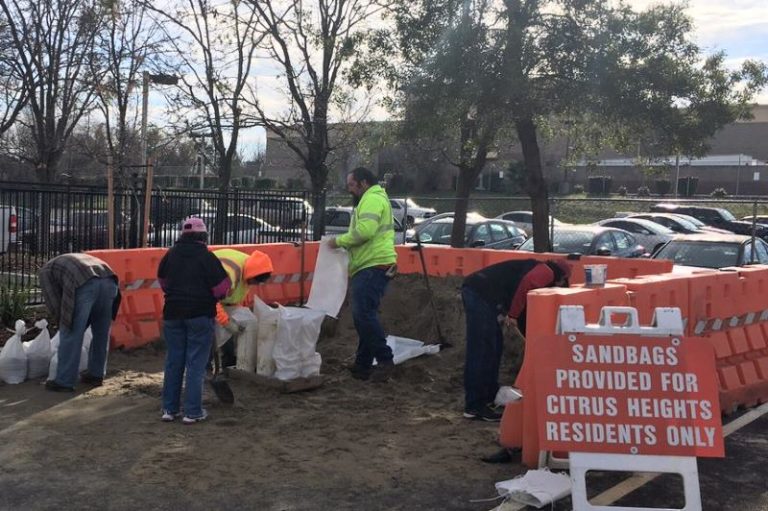
Sandbags will also be available for Citrus Heights residents again this year, and distribution will be expanding to weekends, the city reported. Weekend dates for sandbag pickup will begin on Saturday, Oct. 17 at Citrus Heights City Hall, and then take place for the next following three weekends at C-Bar-C Park.
A limited quantity of sandbags are available on weekends, between 9 a.m. and 12 p.m., on Saturdays Oct. 17, Oct. 24, Oct. 31 and Nov. 7.
Sandbag distribution is also available during the week at City Hall between 9 a.m. and 4 p.m.. Residents must show proof of Citrus Heights residency via an ID card or utility bill. Residents are limited to 10 sandbags each.
For more information on storm readiness, visit the city’s storm ready website at citrusheights.net/419/Be-Storm-Ready. Residents can also visit Sacramento County’s emergency preparedness page at sacramentoready.saccounty.gov.