By Mike Hazlip–
With nowhere safe to return to in her home country, a young Ukrainian artist featured at Citrus Heights City Hall faces an uncertain future.
Like most 18-year-olds, Veronika Buliuk has hopes and dreams for her future. She works part-time at Albedo Arts Studio teaching painting while attending American River College. Buliuk says she plans to continue her art career and become a full-time teacher—if she can remain in the United States with her family.
“I don’t have a house right now because it’s gone,” Buliuk said of the home in Ukraine where she grew up.
One of the first to fall to Russian troops when the invasion began in 2022, Buliuk’s hometown of Hola Prystan has since been flooded when the Kakhovka Dam was breached in June 2023. Although she had already left Hola Prystan with her family before the flood, she received photographs showing the chimney of her home above water.
Being accepted in the first art exhibition at Citrus Heights City Hall was an unexpected surprise for Buliuk. Her artwork was on display during an Art at City Hall exhibit from October 2025 through February 2026.
“I was in shock when they selected me, because there were a lot of artists,” she said, calling it a “good opportunity.”
A call to artists first went out in June from nonprofit Citrus Heights Arts, who spearheaded the City Hall exhibit. A second call for artists occurred in September. Artwork was selected by a panel of Citrus Heights Arts board members and two Citrus Heights City Council members.
Buliuk said that displaying her art serves as an opportunity to share the harrowing story of her family’s flight from war-torn Ukraine.
“I’m thankful for this opportunity for the City Hall of Citrus Heights that I can show my talent here and tell the story about me, my past, and my future,” she said.
Fleeing her homeland at just 14 was a traumatic experience for her family, particularly for Buliuk and her 12-year-old sister. She said they had to navigate several checkpoints where armed soldiers searched the entire vehicle and any electronic devices they found.
“We needed to delete all our social media, all our photos, because they will check, and if something’s wrong with it, they can just kill us,” she said.
Buliuk’s family was one of the lucky ones that made it through the checkpoint and into Kherson, she said, as other vehicles were stopped by Russian troops.
“Behind us was a woman with her children, and they stopped her,” Buliuk said. “Another car went from there, but she was still stopped. I don’t know what was there; maybe they just stopped her and did something with her.”
With both Russian and Ukrainian forces exchanging bombs and artillery fire, it was too dangerous for the family to leave the area on their own. Buliuk’s family waited several hours in Kherson while a group of refugees formed to leave together. She said an official arranged for a one-hour ceasefire while the group of 30 vehicles left the military zone and drove 120 kilometers, or about 74 miles, over roads rutted with tank tracks to a safer area.
Once past Kherson, the family made their way to Mykolaiv, then on to Odesa, where they left their father behind and traveled to Latvia. There, Buliuk says she attended a Russian-speaking school where she faced harassment from other students supportive of the Russian invasion.
The family later reunited with their father in Latvia, applied for a visa, and found a sponsor to come to the United States.
“I want to say thank you to the United States that I’m here, that I’m safe here today,” Buliuk said. “I have a lot of opportunities here to grow in art and to help other students grow in it, and they can feel relaxed because art is important.”
The experience of fleeing her hometown left a lasting impression on Buliuk, who says her artwork took on a darker tone, where she used dark colors and red hues in her paintings for a period.
Teaching art has helped her heal, and helps her students heal, too, she said.
“Children have stress too because if they have any experience in this, it’s very hard for them, for their nervous systems,” she says, adding that she teaches both Ukrainian and American children.
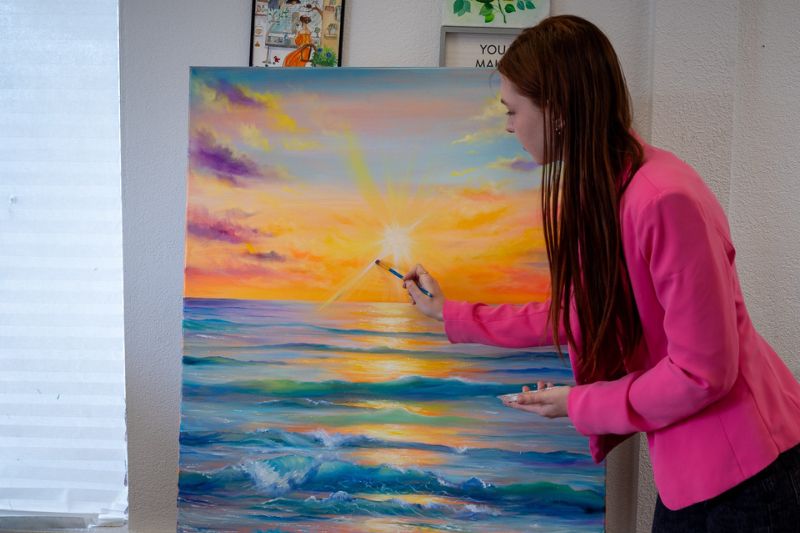
Today, Buliuk paints scenes of Hola Prystan and the surrounding seascapes using brighter colors that she says invoke positive memories of the town where she once lived.
“I just want to show people that there’s going to be something good in the world, not something bad,” Buliuk says. “To show beautiful places, nature.”
Buliuk recently graduated high school with honors and hopes to attend a college in Southern California. For now, she continues to develop her skills at American River College as she and her family work through the immigration process established for Ukrainian refugees.
While Buliuk said that she and her family have been given another two years by the U.S. Citizenship and Immigration Services, her future remains uncertain after that. The status of refugees like Buliuk and her family is becoming increasingly tenuous due to a lack of congressional action, according to a February 2026 report released by Global Refuge.
“I hope that this city, this place, and this country can be my second home,” she said. “I like the people here; they are very kind to me and to my family too.”
Currently, Buljuk lives with her parents and sister in a home in Citrus Heights.