




By Sara Beth Williams–
One of the oldest living residents of Citrus Heights recently marked a major milestone, celebrating his 100th birthday.
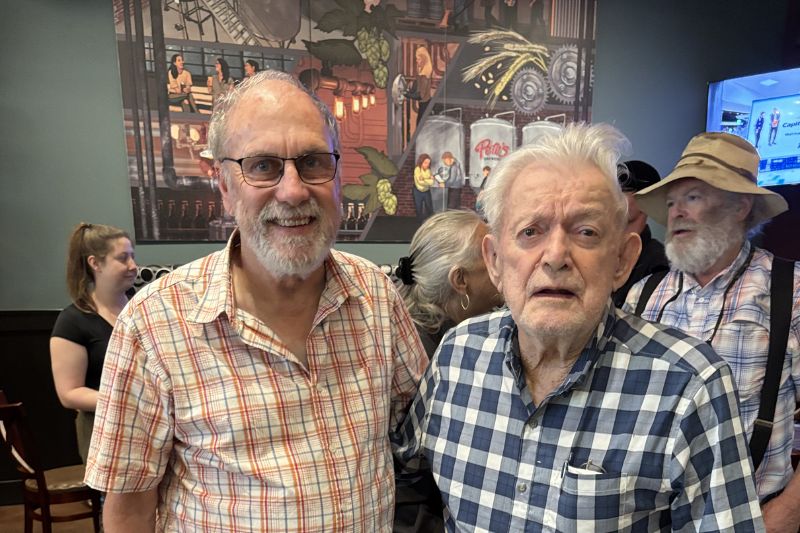
Ted Mitchell, whose family name has long been associated with the region’s agricultural and development history, celebrated turning 100 during a gathering held Sunday, March 15, at Pete’s Restaurant & Brewhouse.
Former Citrus Heights mayor and longtime council member Jeannie Bruins, who has known Mitchell for about four decades said she attended the birthday celebration and shared photos from the event.
“I told Ted, ‘You don’t look a day over 90,’” Bruins said.
Family members, extended relatives, grandchildren, great-grandchildren, and a small group of friends attended the gathering, along with Citrus Heights Historical Society president Larry Fritz.
Mitchell is part of one of the oldest families connected to the area, and his family’s name was recently memorialized through Mitchell Village, a large housing development in Citrus Heights that also includes Mitchell Village Park within its boundaries.
According to the Citrus Heights Historical Society, Mitchell’s family roots in the region stretch back to the 19th century. In an interview recorded by the Historical Society and later featured in a 2025 documentary on the family’s legacy, Mitchell recounted how his great-grandparents, Edward and Zenobia Crabb, immigrated from England and purchased 160 acres of farmland at what is now the northeast corner of Greenback Lane and Sunrise Boulevard in 1866.
Mitchell said the land was purchased for $1,600, paid in gold coins. At the time, all oak trees on the property had to be cleared by hand before crops could be planted. The felled oak trees were converted into charcoal and sold, providing one of the family’s earliest sources of cash income.
In the early years, wheat and hay were the only commercially practical crops because irrigation had not yet reached the area. By 1920, Mitchell’s grandfather, Edward Clay, expanded operations to include grapes and olives, once water became available.
Mitchell’s mother, Bernice, managed the family farm, while his father, Washington Mitchell, operated a service station at the corner of Greenback Lane and Fair Oaks Boulevard.
Growing up during the Depression, Mitchell described his childhood as pleasant but busy, with farm work beginning early and involving nearly every member of the family. In the Historical Society documentary, he recalled milking cows, picking grapes, butchering hogs, and changing engine oil as routine parts of daily life.
The family’s farm included 80 acres of grapes, and picking so many was “a lot of work,” Mitchell said.
Though much of his youth centered on work, Mitchell also remembered his mother insisting he take piano lessons, even if he did not always practice as expected.
“There was very little development up until the mid-1950s,” Mitchell said in an interview, describing a landscape that remained largely rural for much of his early life.
Although retired, Mitchell still maintains ties to the family property. According to Fritz, Mitchell still owns the adobe brick home he chose to keep within Mitchell Village, even after developers offered to build him a replacement home.
The house, built in the 1980s, sits tucked in between rows of newer homes built between 2022 and 2024, Fritz said.
Mitchell currently divides his time between that home and staying with his son and daughter.